In East Africa, a house may look to be perfectly solid when its foundation timbers and walls are eaten out by tropical termites. Sometimes a push is all that is needed to tumble the empty shell on its side.
The moral structure of our modern society is much the same. The frightening increases in crime are only the sound of the invisible termites of immorality and corruption at work. How many more people are actually lawless at heart we cannot know until opportunity comes to express itself.
An example is "decent people" to becoming looters when disasters like earthquakes, riots, and shortages of police let them walk off with someone else's property. People who appear law-abiding get into the act: "Everybody does it--why not I?" All their "righteousness" suddenly goes down the drain.
A very fragile fabric is all that holds our so-called civilized society together. For many, all that remains is a lingering fear of being caught--the outward shell that hides the termites within. But we all owe thanks to the Holy Spirit for restraining this about-to-break-forth universal lawlessness. It is He who is continuing to "strive" with lawless people until He completely withdraws from the human scene as He did in the days of Noah (see Genesis 6:3, 5; Matthew 24:37-39).
This raises a question: If Jesus Christ came to save the world, why is the world getting worse and worse? Especially in North America where we have the highest percentage of church attendance in the world, why is violence more acute than almost anywhere else? Religious liberty has provided Protestant churches with their greatest opportunities in history to preach the gospel. Why then does America give the world its worst example of lawlessness?
The Bible reveals the root of the cause: religious leaders have weakened the authority of God's law in trying to get around the seventh-day sabbath which the Lord has set in the very heart of His law. If we say that God's sabbath commandment does not matter, we destroy the only force the other nine commandments can have! Let us see why.
1. What is the plain reason the Bible gives for the troubles that plague our modern world? Isaiah 24:5.
ANSWER: "Because they have transgressed the __________, changed the __________, broken the __________ __________."
2. How have the Catholic and Protestant churches united in changing God's "ordinance," and breaking "the everlasting covenant"?
We will quote from The Convert's Catechism of Catholic Doctrine, p.50, by the Rev. Peter Geiermann:
"Question: Which is the Sabbath day?
"Answer: Saturday is the Sabbath day.
"Question: Why do we observe Sunday instead of Saturday?
"Answer: We observe Sunday instead of Saturday because the Catholic Church transferred the solemnity from Saturday to Sunday."
Says the Manual of Christian Doctrine: or Catholic Belief and Practice by Daniel Ferris:
"Question: How do you prove that the [Catholic] Church has power to command Feast and Holy-days?
"Answer: By this very act of changing the sabbath into the Sunday, which is admitted by Protestants, and therefore they contradict themselves by keeping Sunday so strictly, and breaking most other Feasts commanded by the same Church" (page 67).
"You may read the Bible from Genesis to Revelation, and you will not find a single line authorizing the sanctification of Sunday. The Scriptures enforce the religious observance of Saturday."
James Cardinal Gibbons, The Faith of Our Fathers, p. 89.
3. Does "the Protestant world" admit that this is true?
(a) "'But,' say some, 'it [the sabbath] was changed from the seventh to the first day.' Where? When? And by whom? No man can tell. No, it never was changed, nor could it be, unless creation was to be gone through again. ... If it be changed, it was that august personage changed it who changes times and laws ex officio--I think his name is DOCTOR ANTICHRIST." Alexander Campbell, "Address to the Readers of The Christian Baptist," No. 111, The Christian Baptist, Feb. 2, 1824.
(b) "The Roman Church ... reversed the Fourth Commandment by doing away with the Sabbath of God's word, and instituting Sunday as a holiday." N. Summerbell, History of the Christian Church, p. 41.
4. Do Roman Catholics continue to challenge Protestants on this matter?
"Nothing is said in the Bible about the change of the Lord's day from Saturday to Sunday. ... That is why we find so illogical the attitude of many non-Catholics, who say that they will believe nothing unless they can find it in the Bible and yet will continue to keep Sunday as the Lord's day on the say-so of the Catholic Church." Leo J. Trese, Catholic priest, The Faith Explained, 1971 edition, p. 243.
History Tells How the Change Was Made
"Not long after the recognition of Christianity by Constantine, the observance of Sunday was required by law. In A.D. 321 all courts of justice, all city dwellers and artisans were required to rest 'on the venerable day of the Sun'--only farmers were exempted, whose work could not be interrupted or delayed." Encyclopedia Americana, 1969 edition, Vol. XXVI, article "Sunday," p. 32.
Emperor Constantine's Sunday law was not based upon Christ's teaching, but upon pagan philosophy. When his Sunday law was enforced, he spoke of it as "the venerable day of the sun"--a pagan custom. Historian Augustus Neander says, "The festival of Sunday, like all other festivals, was always only a human ordinance." The chief purpose of Constantine's edict was to enforce Sunday on Christians in order to fuse these two religions, paganism and Christianity. But gradually this pagan festival caused apostasy in the church and a departure from Bible truth. Through the centuries, the church at Rome, having set its seal of approval on the change of the day of worship, commanded everyone to keep Sunday as a holy day instead of God's true holy sabbath.
"At the Council of Laodicea, A.D. 364, the following edict was issued: 'Christians shall not Judaize and be idle on Saturday (original Sabbath), but shall work on that day; but the Lord's day they shall especially honor, and, as being Christians, shall, if possible, do no work on that day. If, however, they are found Judaizing, they shall be shut out from Christ." Rev. Charles Hefele, History of the Councils of the Church, Vol. II, p. 316.
5. Have calendar changes disturbed the 'weekly sabbath?
No. The facts can be verified in any encyclopedia. The Julian Calendar was in use when Jesus was on the earth. The week in use in the Middle East at that time is the same as the week of our calendar today, which is the Gregorian. The days of the month are different, but the days of the week were never changed.
The Julian Calendar used for sixteen centuries was not quite accurate in the length of its year, being nearly one quarter of an hour too long. By 1582 the vernal equinox had receded, and fell on March 11, ten days earlier than the March 21 date to which the Catholic Church had, in A.D. 321, anchored the time of Easter.
Pope Gregory XIII led out, and the Gregorian Calendar began to function at Rome on Friday, the fifth of October, 1582. Friday the fifth was changed to Friday the fifteenth. The week remained untouched, and the days of the week likewise.
The seventh day of the week today is the same as when Christ was here, and calendar changes have not affected it. It is true that in connection with the French Revolution the French tried a ten-day week, but it did not endure. It is well known also that Soviet Russia introduced a five-day week, then a six-day week, and forbade the printing of a seven-day week calendar. All this was a modern attempt to banish the Lord's weekly rest day. But Soviet Russia failed.
        1585 OCTOBER 1585
Sun. Mon. Tue. Wed. Thu. Fri. Sat.
       1    2    3    4   15   16
 17   18   19   20   21   22   23
 24   25   26   27   28   29   30
 31
6. You will remember our lesson on Daniel 2, where the great image symbolized the rise and fall of nations, and the end of "world history at the second coming of Jesus. Daniel was given another prophetic vision in chapter 7 with many more details included.
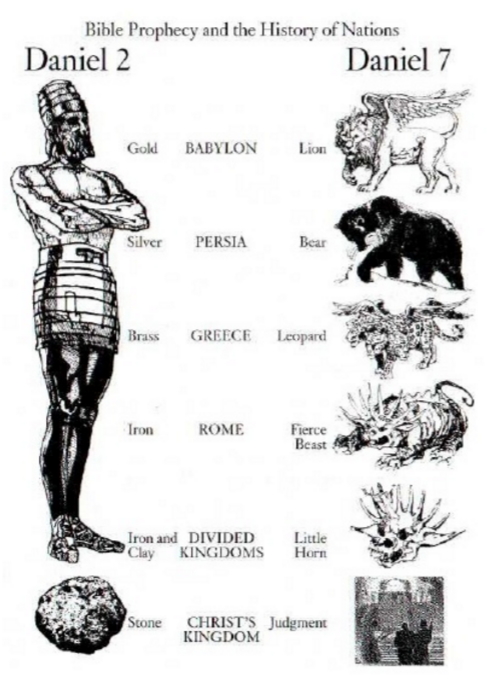
The Biblical Interpretations of Symbols Used in Prophecy
WINDS refer to warfare or strife (Jeremiah 49:36, 37). WATERS are people, multitudes, and nations (Revelation 17:15). BEASTS are kings or kingdoms (Daniel 7:17, 23).
With these symbols in mind, read Daniel, chapter 7. The dreadful fourth beast in the vision is pictured as having seven heads, ten horns.
7. What is the significance of the ten horns? Daniel 7:23, 24.
ANSWER: "And the __________ __________ out of this kingdom are __________ __________ [or kingdoms] that shall arise."
We have already seen that the fourth kingdom, corresponding to the legs of iron of the image, was the kingdom of pagan Rome. Between the years 351 A.D. and 476 A.D. the empire of Rome was invaded by heathen tribes from the North. Ten smaller kingdoms sprang up out of the ruins of pagan Rome.
8. Who is represented by the little horn and how does the Bible describe this power? Daniel 7:8.
ANSWER: "I considered the horns, and, behold, there came up among them another __________ __________, ... and, behold, in this horn were __________ like the __________ of __________, and a __________ __________ __________ __________."
(a) "Came up out of the fourth beast. "Daniel 7:7, 8, 23.
The fourth kingdom according to Daniel 2, the legs of iron, was Rome. The ten horns are the same as the ten toes of the image--ten kingdoms which arose out of the ruins of the pagan Roman empire. "The arms of the Republic, sometimes vanquished in battle, always victorious in war, advanced with rapid steps to the Euphrates, the Danube, the Rhine, and the ocean; and the images of gold, or silver, or brass, that might serve to represent the nations and their kings, were successively broken by the iron monarchy of Rome." Edward Gibbon, The Decline and Fall of the Roman Empire, Vol. Ill, general observations following chapter 38, p. 634.
"Out of the ruins of political Rome, arose the great moral empire in the 'giant form' of the Roman Church." A. C. Flick, The Rise of the Mediaeval Church.
(b) "Came up among the ten horns or kingdoms." Verse 8.
Historian James Harvey Robinson declares: "Besides the Emperors at Constantinople, and the various German kings, there grew up in Europe a line of rulers far more powerful than any of these, namely, the popes." Mediaeval and Modern Times, p. 40.
(c) "Another shall rise after the ten horns." Verse 24.
A crisis occurred in A.D. 476 causing the abdication of the Emperor. Barbarian invaders brought about the collapse of the old Roman Empire. In A.D. 533 Emperor Justinian passed a decree recognizing the Bishop of Rome as "Head of all the Holy Churches." In A.D. 538 this decree was put into effect. It was because of this that the papacy attained full political power after the division of Rome's territories by barbarian kingdoms.
(d) "Diverse [different] from the other horns." Verse 24.
"Long before the fall of Rome, there had begun to grow up within the Roman Empire an ecclesiastical state. ... Another consequence of the fall of the Roman power in the west was the development of the papacy. In the absence of an Emperor in the west, the popes rapidly gained influence and power and soon built up an ecclesiastical empire that in some respects took the place of the old empire." General History for Colleges, pp. 348, 316.
(e) "Whose look was more stout than his fellows." Verse 20.
"Besides the emperors at Constantinople and the various German Kings, there grew up in Europe a line of rulers far more powerful than any of these, namely, the popes. ... the longest and mightiest line of rulers that the world has ever seen." Medieval and Modern Times, pp. 40, 41.
The American Catholic Quarterly Review, April, 1911, said: "Long ages ago, when Rome through the neglect of the Western emperors was left to the mercy of the barbarous hordes, the Romans turned to one figure for aid and protection, and asked him to rule them; ... and thus ... commenced the temporal sovereignty of the popes. And meekly stepping to the throne of Caesar, the vicar of Christ took up the scepter to which the emperors and kings of Europe were to bow in reverence through so many ages."
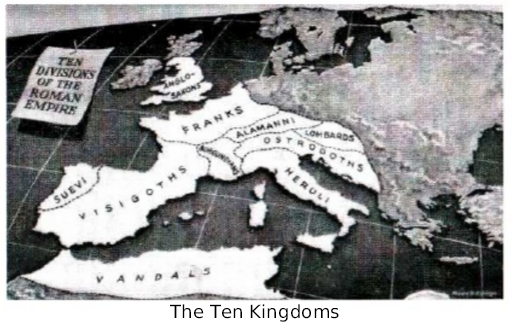
(f) "Plucked up three kingdoms." Verses 8, 20, 24.
The "little horn," in its fight for power, will subdue three kingdoms which oppose his ambition. What does history say? Edward B. Elliot writes:
"I might cite three [kingdoms] that were eradicated from before the pope out of the list first given, viz. the Heruli, under Odoacer, the Vandals, and the Ostrogoths." Horae Apocalypticae, Vol. 111, p. 134, note 1.
In 533 A.D. the Emperor Justinian of the East made a decree in which he exalted the pope to be the head of all the churches. To make effective this new decree, he sent his general Belisarius with an army into Africa to crush the opposing Vandals. The same general then fought against the Ostrogoths, finally driving them out of Italy in 538 A.D. Thus the three kingdoms were uprooted from before the "little horn."
The seven kingdoms that remained were--
(g) "Shall speak great words against the most high." Verse 25.1. Saxons ........ English 2. Franks ........ French 3. Alemani ....... Germans 4. Burgundians ... Swiss 5. Lombards ...... Italians 6. Visogoths ..... Spanish 7. Suevi ......... Portuguese
"Some of the arrogant and blasphemous claims made by the papacy are quoted here from Ferraris' Ecclesiastical Dictionary:
"The pope is of so great dignity and so exalted that he is not mere man, but as it were God, and the vicar of God. ... The pope is crowned with a triple crown, as king of heaven and of earth, and of the lower regions. ... The power of the Roman Pontiff by no means pertain(s) only to heavenly things, to earthly things and to things under the earth, but even over angels, than whom he is greater. ... For he is of so great dignity and power that he forms one and the same tribunal with Christ. ... The pope is as it were God on earth." Prompta Bibliotheca, Article "Papa" II, Vol. VI, pp. 26-29.
(h) "Shall wear out the saints of the Most High." Verse 25.
During the Dark Ages, which began in 538 A.D., some millions of Christians were persecuted to death by the papacy. This horrible record is one of the darkest stories of human history. We quote now from a few historians:
"That the church of Rome has shed more innocent blood than any other institution that has ever existed among mankind, will be questioned by no Protestant who has a competent knowledge of history." Lecky's History of Rationalism in Europe, Vol. II, p. 32.
Let a Roman Catholic author state the facts: "The church [Roman Catholic] has persecuted. Only a tyro [very ignorant person] in history will deny that. ... Protestants were persecuted in France and Spain with the full approval of the church authorities. We have always defended the persecution of the Huguenots [French Protestants], and the Spanish Inquisition. ... When she thinks it good to use physical force, she will use it. ... Will she give absolute freedom and equality of all churches and all faiths? [The] Catholic Church gives no bonds for her good behavior." The Western Watchman, December 24, 1908.
The Law of God
(i) Shall "think to change times and laws." Verse 25.
The Roman Catholic Prompta Bibliotheca by Ferraris says: "The pope is of so great authority and power that he can modify [change], explain, or interpret divine laws." Vol. VI, p. 29.
In the Roman Catholic Catechisms used for teaching the common people, the law of God is modified, so that the second commandment forbidding the worship of images has been deleted. The fourth is shortened, so as to support the observance of the first day of the week (Sunday) in place of the true sabbath. The tenth is divided into two commandments.
(j) God's people "given into his hand until a time and times and the dividing of time." Verse 25.
A "time" is a year. "Times" would therefore be two years, and the "dividing of time" a half a year. Thus altogether, the little horn power would continue in authority for three years and a half, prophetic time, with the saints delivered into his hand all that while.
This same period of time is mentioned in Revelation 12:14, and in Revelation 13:5 it is again spoken of as 42 months, counting twelve months to the year (12 x 3 1/2 = 42). Again we find the same time period in Revelation 12:6, as 1260 days, counting 30 days to the month for 42 months (42 x 30 = 1260). The little horn, the papacy, would rule supreme in Europe, persecuting the saints of God, for 1260 literal years (the symbol of a day standing for a year).
History confirms this. Justinian made a decree in 533 A.D. giving the papacy unlimited power over all the churches. This decree went into effect in 538 A.D. when the last of the three kingdoms opposed to the papacy was pulled up by the roots. Thus the time for beginning the 1260 years of papal rule is 538 A.D.
Exactly 1260 years later, the papacy lost its temporal power. On February 20, 1798, Berthier, General of the French army under Napoleon, took the Pope prisoner in Rome, effectually putting an end to the papacy's temporal power in Europe. After that time there was virtually no persecution of the saints in Europe. They were free to worship God.
The kingdom will be given to those for whom it has been prepared since the foundation of the world. This vision of Daniel concerns us in these last days, lest we serve the little horn ignorantly, and share in its final destruction.
It's "good news" that the judgment of Heaven is even now taking away the "dominion" of the little horn, "to destroy it unto the end. Today we may know that this power has lost its hold over us. Not only in the world around us, but in our own hearts this dominion of evil is taken away, as we by faith follow Christ in His final work of judgment.
9. In the conflict between "the little horn " and the Lord Jesus, where do you choose to stand ? __________.
"Casting all your care upon Him; for He careth for you." 1 Peter 5:7 "Pray without ceasing." 1 Thessalonians 5:17