He is busy day and night performing a great work--preparing a people to be ready when He comes. It's the most important work being done in the world today.
He has an "office," a headquarters where this work is directed. It is the heavenly sanctuary. God directed Moses to build an earthly sanctuary, "that I may dwell among them" (Exodus 25:8). It was built according to a "pattern," a "shadow" or type of the heavenly one.
In the "holy place" was a gold table for special bread, the seven-branched candlestick or lamp stand, and a gold altar of incense. The table stood on the north, and on the south was the candlestick, with its seven lamps. Its branches were ornamented with exquisitely wrought gold flowers, resembling lilies, and the whole was solid gold. There being no windows in the tabernacle, the lamps shed their light day and night. The gold altar of incense stood before the veil separating the holy place from the most holy place.
Beyond the inner veil was the solemn "holy of holies," where was centered the symbolic service of atonement and intercession. It formed the symbolic connecting link between heaven and earth. A chest, called "the ark of the covenant," was the only furniture there, a depository for the tables of stone on which God Himself had inscribed the Ten Commandments. Gold angels called "cherubim" covered it. Above it was the holy Shekinah--the visible manifestation of the divine presence. All this was but a dim reflection of the glories of the true sanctuary in heaven, the great center of the work for man's redemption. Jesus is there; but what is He doing?
1. We will focus on a verse in the prophetic book of Daniel. Jesus has set up an appointment with His people. Read Daniel 8:14, and note the time, place, and the work to be accomplished.
ANSWER: "Unto __________ __________ and __________ __________ __________ [time] then shall the __________ [place] be __________ [work]."
2. What was God's purpose in telling Moses to build a sanctuary? Exodus 25:8.
ANSWER: "Let them make Me a __________; that I __________ __________ __________ __________."
3. Moses was given a pattern (Exodus 25:9, apian) to follow. What did its priests represent? Hebrews 8:5.
ANSWER: "Who serve unto the __________ and __________ of __________ __________.
The earthly sanctuary is a lesson book for us to learn what the heavenly sanctuary is like.
4. Who is our great High Priest? Hebrews 4:14.
ANSWER: "We have a great high priest ..., __________ the __________ of __________."
5. Where does He minister? Hebrews 8:1, 2.
ANSWER: "Such an High Priest, who is __________ on the __________ __________ of the __________ of the __________ in the __________; ... a minister of the __________, and of the __________ __________."
6. In Hebrews 9:1-5, Paul describes the earthly sanctuary. It was divided into two sections with veils at the entrance of each part. Write the different objects in each place:
FILL IN THE BLANKS: "... wherein was the __________, and the __________, and the __________; ... which had the __________ __________, and the __________ of the __________ ..., wherein was the __________ __________ that had __________, and __________ __________ that budded, and the __________ of the __________; and over it the __________ of glory shadowing the __________.
7. As there was an ark containing God's law in the earthly sanctuary, what does John see in the heavenly? Revelation 11:19.
ANSWER: "And the temple of God __________ __________ in __________, and there was seen in his __________ the __________ of his __________."
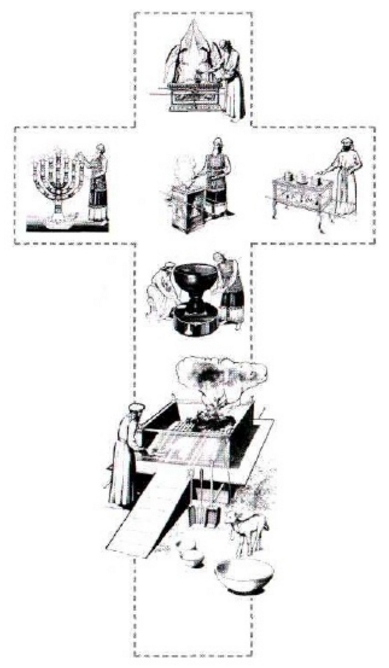
Since the earthly sanctuary was a type or shadow, we find in it many illustrations of Christ's work for us. In Leviticus 4 is the record of how by faith the people laid their sins on the lamb (see Leviticus 4:32, 33; compare John 1:29, Rev. 13:8). "The cleansing of the sanctuary" is described in Leviticus 16 as the day of atonement.
8. The one day in the year when "the high priest alone" entered the second room or most holy place was the Day of Atonement. This was the cleansing of the sanctuary, and typified Christ's final work of disposing of the sin problem which has plagued God's universe like an open sore for thousands of years. Read about the Day of Atonement in Leviticus 16. Note especially verses 29, 30, 33, 34:
FILL IN THE BLANKS: (Verse 29-30) "In the seventh month, on the tenth day of the month, ... shall the priest make an __________ for you, to __________ __________, that ye may be __________ from all your __________ before the Lord."
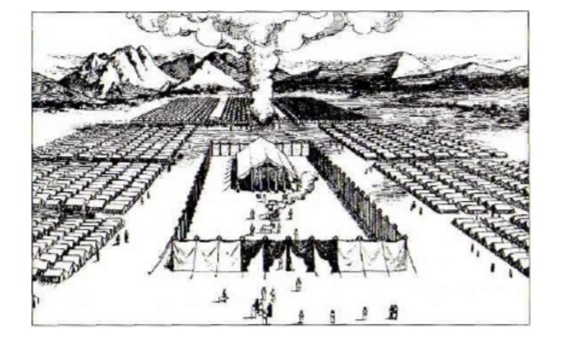
"Let them make me a sanctuary that I may dwell among them."
Even now the Jewish Day of Atonement (Yom Kippur) symbolizes to pious Jews the Day of Judgment. In a beautiful and impressive drama, the ancient high priest would symbolically "cleanse" away all deeply buried roots of sin in the nation of Israel, and banish Satan the tempter from the congregation. This service typified the final extinction of Satan and sin from God's universe and directed the people's minds to the time when He will create "new heavens and a new earth, wherein dwelleth righteousness" (2 Peter 3:13).
On the cross our Saviour offered Himself a perfect sacrifice, complete enough to save every sinner in the world. Yet without the work of the final "Day of Atonement" in the heavenly sanctuary, the sin-problem would never be completely solved. Without Christ's final ministry in the sanctuary, it would continue to run like an open sore, pardoned but never eradicated.
9. The Day of Atonement was a day of cleansing from sin. How are we cleansed today? 1 John 1:7, 9.
ANSWER: "If we __________ in the __________, as He is in the light, we __________ __________ one with another. ..." "If we __________ our __________, He is faithful and just to forgive us our sins, and to __________ __________ from __________ __________."
Both confession and forsaking of sin, and following Christ daily, are a part of this special cleansing work (see also Hebrews 9:22, 23). But it is the work of the High Priest that cleanses us. We do not "cleanse the sanctuary," He does; but it is our work to cooperate with Him, to let Him do it in our hearts as the record is cleansed in heaven.
10. What precious work is the Saviour doing for all who turn to Him in faith? 1 John 2:1.
ANSWER: "We have an __________ with the Father, __________ __________ the righteous."
An "advocate" is a defense lawyer who pleads for the accused in a court trial. This is Christ's full-time job--to defend you and me from the condemnation that sin has brought upon us.
How does He defend us? Not by excusing us, nor by saying that sin is all right. He defends us by bearing our condemnation for us, suffering our punishment, dying our death for us, and removing the sin from us. He changes our selfish, sinful motivation so that we actually learn to hate sin and selfishness and to love righteousness. As our High Priest, Christ is our spiritual Physician, our divine Psychiatrist, who heals our sin-sick souls.
Don't misunderstand: the Father is not our enemy who needs to be persuaded. Christ is an advocate with Him; our enemy is Satan who accuses us and says our case is hopeless. The important decision we must make is: will we believe our Saviour, or believe our enemy?
11. For how many people has Christ already paid the ransom price? 1 John 2:2.
ANSWER: "He is the __________ for our sins: ... for the sins of __________ __________."
"The wages of sin is death," even the second death (Romans 6:23; Revelation 2:11). Christ has "tasted" that death "for every man" (Hebrews2:9). Not one person needs ever to die that second death, unless he rejects what Christ has already done for him. "Propitiation" means ransom-price. We all owe even our physical life to that sacrifice of Christ. We are already infinitely in debt to Him. Every loaf of bread is stamped with His cross. Whether or not we believe in Him, we owe everything to Him (see Romans 5:18; 6:15; 2 Corinthians 5:19-21).
12. What glorious new motivation fills the heart that is cleansed by Christ? Romans 6:14, 15.
ANSWER: "Ye are not under the __________, but under __________."
When the heart appreciates what it cost the Son of God to redeem us, we say "Thank You" by yielding all we are to Him. This "under grace" motivation is more powerful than the motivation to sin, because where sin "abounds" grace does "much more abound" (Romans 5:20). Light is stronger than darkness, love is stronger than hate, Christ is stronger than Satan, and grace is stronger than sin!
It is not the fear of punishment, or the hope of everlasting reward that leads the disciples of Christ to follow Him. They see the Saviour's matchless love revealed throughout His life on earth from the manger of Bethlehem to Calvary's cross. The sight of Him attracts, it softens and subdues the soul. Love awakens in the heart of those who look. They hear His voice, and they follow Him. Do you want a happy life? That's it!
13. Do you choose this "happy life" of living in cooperation with Christ today? __________.
"Casting all your care upon Him; for He careth for you." 1 Peter 5:7 "Pray without ceasing." 1 Thessalonians 5:17