After Adam and Eve sinned in the garden of Eden and they had to be expelled from their Paradise home they were not left without hope. The promise of restoration was given to them immediately, and they were given assurance of a coming Redeemer who would one day make it possible for them to be returned to their lost estate. However, the cost of the restoration would be something beyond anything they could understand at the time. Speaking to the serpent, Satan actually, God said: "And I will put enmity between thee and the woman, and between thy seed and her seed; it shall bruise thy head, and thou shalt bruise His heel."
This was the first unfolding of the Everlasting Covenant. God was revealing to man His plan to redeem lost humanity no matter what the cost. As we look at this verse, we are impressed with the fact that there is much in the depths of its meaning which does not appear in a superficial reading. The "enmity," for example, indicates that somehow God counteracted the effects of sin in alienating man from his Creator. Also, the expression, "bruise thy head," would be better translated, "shatter thy head," according to an ancient Talmudic understanding of the text. God was telling our first parents about His plan to save the world, a plan which had been formulated eons before. As we read in The Desire of Ages, page 22: "The plan for our redemption was not an afterthought, a plan formulated after the fall of Adam. It was a revelation of the 'mystery which hath been kept in silence through times eternal.' Romans 16:25 RV."
Fulfillment of this promise did not come until four thousand years later. The story is told in Matthew 1:21: "And she shall bring forth a son, and thou shalt call His name JESUS: for He shall save His people from their sins." In the manger of Bethlehem was born the One whose commitment to the cross had saved the world from destruction, and who eventually would restore humanity completely to the glories of the new earth.
Sixteen centuries went by, and as Noah and his family came out of the ark, and all the animals which had gone into the ark with them, God repeated the promise of the Everlasting Covenant. This time there was seen "the bow of promise" which symbolized God's assurance to man that never again would the earth be destroyed by a flood.
More centuries went by, and we come to the time of Abraham, the man from Ur of the Chaldees. He had grown up in the environment of heathenism, born and raised in a heathen home, but he had renounced the moon worship everywhere about him and chose to worship the true God. God called him from the land of his birth and promised to give him and his posterity the land of Canaan for an inheritance. Implicit in the promise was the promise of the new earth. Notice how God spoke the words of the everlasting covenant in Genesis 17:1-8:
And when Abram was ninety years old and nine, the Lord appeared to Abram, and said unto him, I am the Almighty God; walk before me, and be thou perfect. And I will make my covenant between me and thee, and will multiply thee exceedingly. And Abram fell on his face: and God talked to him, saying, As for me, behold, my covenant is with thee, and thou shalt be a father of many nations. Neither shall thy name any more be called Abram, but thy name shall be Abraham; for a father of many nations have I made thee. And I will make thee exceeding fruitful, and I will make nations of thee, and kings shall come out of thee. And I will establish my covenant between me and thee and thy seed after thee in their generations for an everlasting covenant, to be a God unto thee, and to thy seed after thee. And I will give unto thee, and to thy seed after thee, the land wherein thou art a stranger, all the land of Canaan, for an everlasting possession, and I will be their God."
Understand clearly that this more detailed unfolding of the everlasting covenant was not any different from the covenant God had given to Adam and later to Noah. At this point we should mention that never had God any other plan for the saving of a lost world than this one He had given to Adam and Noah and Abraham.
E. J. Waggoner in his book, The Glad Tidings, explains the covenants in a clearer manner than we find anywhere else in the 1888 message or for that matter, anywhere else in Adventism. Let us begin by reading from page 71:
The covenant and promise of God are one and the same. This is clearly seen from Galatians 3:17, where Paul asserts that to disannul the covenant would be to make void the promise. In Genesis 17 we read that God made a covenant with Abraham to give him the land of Canaan for an everlasting possession. Galatians 3:18 says that God gave it to him by promise. God's covenants with men can be nothing else than promises to them: "Who hath first given to Him, and it shall be recompensed unto him again? For of Him, and through Him, and to Him, are all things." Romans 11:35-36.
Galatians 3:17 and 18 read like this: "And this I say, that the covenant, that was confirmed before of God in Christ, the law, which was four hundred and thirty years after, cannot disannul, that it should make the promise of none effect. For if the inheritance be of the law, it is no more of promise: but God gave it to Abraham by promise."
Waggoner continues his comments on the covenants as follows, page 72:
Do not forget as we proceed that the covenant and the promise are the same thing, and that it conveys land, even the whole earth made new, to Abraham and his children. Remember also that since only righteousness will dwell in the new heavens and the new earth, the promise includes the making righteous of all who believe.
Now this is good news! Not only does God promise us the wonderful real estate of the new earth, but also the righteousness we need to live there. Here is one of the beautiful promises of the 1888 message which completely destroys all elements of legalistic thinking as we try to overcome sin. This cannot be done in our own strength. The victory for which we yearn comes by faith and faith alone, and we have to remember that God has promised us that righteousness, but He does expect us to believe. Also, He has to have our permission!
We read again from The Glad Tidings, page 76:
"Is the law then against the promises of God?" Not at all. If it were, it would not be in the hands of the Mediator, Christ, for all the promises of God are in Him. 2 Corinthians 1:20. We find the law and the promise combined in Christ. We may know that the law was not and is not against the promises of God from the fact that God gave both the promise and the law. ... But all the same it is not against the promise and brings no new element in. Why? Simply because the law is in the promise. The promise of the Spirit includes:
"I will put My laws into their minds, and write them on their hearts." Hebrews 8:10. And this is what God had done for Abraham when He gave him the covenant of circumcision. Read Romans 4:11, 2:25-29; Philippians 3:3.
There is no conflict here between the covenant, the promises, the law, and so on. They are all part of the same beautiful package. This is the message which comes through so consistently from these analyses Waggoner makes on the covenant question. Listen further:
The law is righteousness, as God says: "Hearken to Me, you who know righteousness, the people in whose heart is My law." Isaiah 51:7. So, then, the righteousness which the law demands is the only righteousness that can inherit the promised land. It is obtained, not by the works of the law, but by faith. The righteousness of the law is not attained by human efforts to do the law, but by faith. See Romans 9:30-32. Therefore, the greater the righteousness which the law demands, the great is seen to be the promise of God. For He has promised to give it to all who believe. (p. 77).
If anyone should protest that the righteousness which the law demands is so great that a man lost in sin in this world has no hope of ever reaching it, then God would simply say: "Of course you cannot reach it! That's why I am promising it to you as a gift! And if you think the righteousness that the law demands is so terribly great, that goes to show how great these promises are!" Good news? There is none greater! Waggoner continues:
Yes, He has sworn it! When, therefore, the law has spoken from Sinai" out of the midst of the fire, of the cloud, and of the thick darkness, with a great voice" (Deuteronomy 5:22), accompanied by the sounding of the trump of God and with the whole earth quaking at the presence of the Lord and His holy angels, the inconceivable greatness and majesty of the law of God was shown. To everyone who remembered the oath of God to Abraham it was a revelation of the wondrous greatness of God's promise; for all the righteousness which the law demands He has sworn to give to everyone who trusts Him. The "loud voice" with which the law was spoken was the loud voice that from the mountain tops proclaims the glad ridings of the saving mercy of God. See Isaiah 40:9. (ibid.).
How the children of Israel misunderstood the experience of Sinai!
They were so terrified at the thunders and lightnings and the "loud voice" of God that they begged Moses to plead with God never to speak directly to them again, but to communicate with them only through Moses. Actually, they were listening to good news, spoken in tones of thunder, as only God can. God was speaking to them words of the most wonderful "glad tidings." The same paragraph continues:
God's precepts are promises; they must necessarily be such, because He knows that we have no power! All that God requires is what He gives. When He says, "Thou Shalt not," we may take it as His assurance that if we but believe Him He will preserve us from the sin against which He warns us.
All we need to do is to believe that promise and to think of the law as beautiful and wonderful promises. God's law is not a series of harsh prohibitions. When God says, "Thou shalt not take the name of the Lord thy God in vain," He is in actual fact saying, "I am promising you that you will not take My name in vain. Only believe!" God says, "Thou shalt not covet." What He actually says is, "I am promising you that you will not covet, if you will truly believe!" If God says, "Thou shalt not steal," and someone protests, "But I grew up in the streets of London, and the only way I know to make a living is picking pockets. If I see a man in a crowd with his back to me and his billfold sticking two inches out of his back pocket, and I take it, to me that is not stealing. It's simply accepting a gift!" God would probably reply gently, "That thinking of yours, which right now more closely resembles a corkscrew than anything else, is going to be as straight as an arrow by the time I'm through with you! But you must believe!"
God's law is not an enemy, but a protective friend. It is much like the traffic light, which may hold you up for a few seconds, but does so to keep you from harm. If you decide to vent your frustration by shooting out the lights and then barge into the intersection you do nothing but heap trouble for yourself. God's law does not deprive you of your freedom, but gives you the only real liberty you can ever hope to know.
Let it be made plain that the way of God's commandments is the way of life. God has established the laws of nature, but His laws are not arbitrary exactions Every 'Thou shalt not', whether in physical or natural law, implies a promise. If we obey it, blessings will attend our steps. God never forces us to do right, but He seeks to save us from the evil and lead us to the good. (Ministry of Healing, p. 114).
Here is a statement, well known by most of us, and the reference is easy to remember, Christ's Object Lessons, p. 333.
As the will of man cooperates with the will of God, it becomes omnipotent. Whatever is done at His command may be accomplished in His strength. All His biddings are enablings.
Heavenly beings do not render service in the spirit of legality. When Satan rebelled against the law of God, the thought that there was a law came to the angels almost as an awakening to something unheard of. It was as if they said among themselves, "You mean we have been keeping a law all this time? Why didn't someone tell us?" The love which the angels have for their Creator makes their service a joy (see Ministry of Healing, p. 109).
E. J. Waggoner proceeds further to explain the covenants in The Glad Tidings, page 100, as follows:
The apostle when speaking of Hagar and Sarah says: "These women are two covenants." These two covenants exist today. The two covenants are not matters of time, but of condition. Let no one flatter himself that he cannot be bound under the old covenant, thinking that its time has passed.
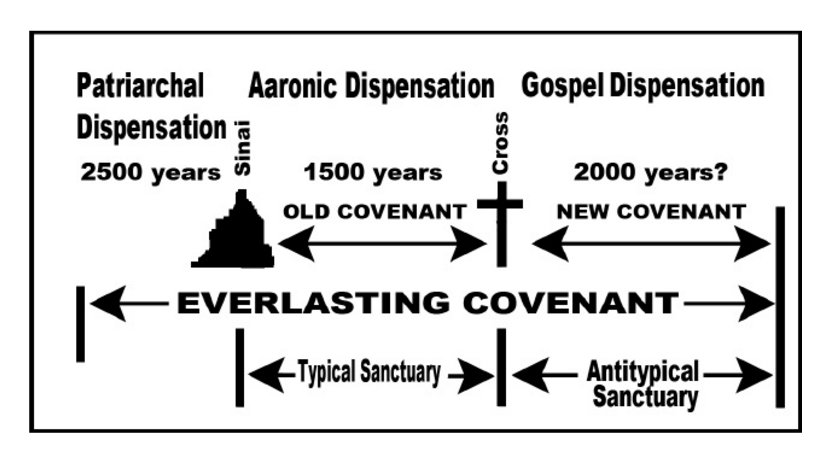
This is where the 1888 messengers went far beyond the traditional teaching of the covenant question in Adventism. For so long, and even to the present time, we have taught that the Everlasting Covenant covered the time from Eden to Sinai, then God changed His plans, for some reason, and introduced the old covenant, which lasted from Sinai until the cross, and then decided to go back to His original plan, only now calling it the New Covenant. Waggoner overthrew all this. He showed that God never had more than one way to save the human race, and that was expressed in His original covenant with man, the Everlasting Covenant, which we also call the New Covenant today.
Then what, someone may ask, is the Old Covenant? The Old Covenant is man's way to save himself. Salvation and righteousness by works, in all of its varieties, is always old covenantism.
Consider the example of Cain and Abel. There we have the Old and the New Covenants side by side. Abel followed God's plan and brought a lamb for the sacrifice. This was new covenantism; he believed the promises of God. By contrast Cain decided that, since he did not tend sheep but grew fruits and vegetables, an offering of garden produce would be just as good. God, in all probability, reasoned with Cain, trying to explain to him that his offering could not possibly symbolize the blood of the promised Messiah, toward which such a sacrifice should point, and that He could not accept such an offering as an offering for sin. Cain would not listen, and the result was the world's first murder. A clear example of new and old covenantism!
Down to the time of Noah. Noah believed God and built an ark, as God had told him to, to save him and any others who chose to believe. But multitudes of that time decided that if an emergency should arise they would handle it in their own way. Old and new covenantism once again.
Sarah and Hagar are the classic examples of the covenants. God had promised Abraham an heir through Sarah. But since neither Sarah nor Abraham believed that Sarah could possibly have a child at her age, they decided to follow the law of the land. This provided that, when it appeared that the head of the household would die without an heir, it was the duty of the wife to provide from among her servant women one who would give the heir. This is how Hagar came into the picture. Sarah was God's method of providing an heir. Hagar was man's idea. What was the result? Ishmael was born of Hagar, and some time after that Isaac was born of Sarah. And the descendants of Isaac and Ishmael have been at one another's throats ever since. Every Middle East conflict, Arab versus Jew, can be traced back to the births of Ishmael and Isaac. All the innocent ones who suffer in these wars, women and children, will they ever know that their troubles go back four thousand years, to a thing called old covenantism?
Finally, we come to Sinai. Here we read in Exodus 24:3: "And Moses came and told the people all the words of the Lord, and all the judgments: and all the people answered with one voice, and said, All the words which the Lord hath said will we do." And again in verse 7:
"And he took the book of the covenant, and read in the audience of the people: and they said, All that the Lord hath said will we do, and be obedient." God did not ask them to make these promises to Him. Were these promises worth anything? Hardly had Moses turned his back, when he returned from receiving from God the tables of stone, the very ones who had made the promise of obedience to God were dancing around an idol of gold. So much for man's promises!
Waggoner tell us again in The Glad Tidings, page 99:
Then did not God himself lead them into bondage? Not by any means, since He did not induce them to make that covenant at Sinai. Four hundred and thirty years before that time He had made a covenant with Abraham which was sufficient for all purposes.
When men make promises to God they cannot keep, they are following a course which God never required. What God has done is ask His people to believe His promises to them.
After the flood God made a "covenant" with every beast of the earth, and with every fowl; but the beasts and the birds did not promise anything in return. Genesis 9:9-16. They simply received the favor at the hand of God. That is all we can do--receive. God promises us everything that we need, and mote than we can ask or think, as a gift. We give Him ourselves, that is nothing. And He gives us Himself That is, everything. That which makes all the trouble is that even when men are willing to recognize the Lord at all they want to make bargains with Him. They want it to be an equal "mutual" affair--a transaction in which they can consider themselves on a par with God. But whoever deals with God must deal with Him on His own terms, that is, on a basis of fact--that we have nothing and are nothing, and He has everything and is everything and gives everything. (ibid. p. 71).
Remember what Waggoner told us earlier: these two covenants exist today. Evidences abound of examples of old covenantism among us today. A good example is this one from Waggoner of making promises to God. How much is a promise today worth? Note this from Steps to Christ, page 47:
You desire to give yourself to Him, but you are weak in moral power, in slavery to doubt, and controlled by the habits of your life of sin. Your promises and resolutions are like ropes of sand. You cannot control your thoughts, your impulses, your affections. The knowledge of your broken promises and forfeited pledges weakens your confidence in your own sincerity.
And yet, in spite of all this, there are cases where we are actually instructing the little ones in the Sabbath School divisions to make all manner of promises to God. "Promise me you will be true in every little thing you do." And another, "I promise that I'll always take the paths that His commandments make." That sort of thing. These are all examples of old covenantism.
Furthermore, there crops up constantly the idea of "we do good things so that we can be in heaven one day." This "salvation by works" theme is seen in such a rhyme as this: "Well, we can all see Him one day, if His words we will obey." In other words, we obey so that we can receive a reward. And listen to this: "Helping mother is lots of fun in getting all her housework done. I know that this makes Jesus glad; it helps make up for when I'm bad." I listened to a friend of mine preaching about this once and he asked: "How many dishes am I going to have to wash in the kingdom of heaven one day to make up for all the bad things I have done?"
And here I do want to make it clear that I am not trying to be unkindly critical of someone else's work. These verses were produced in a sincere effort to give the little ones in the Sabbath School an incentive to be obedient and good. The motive behind it all is simply beyond criticism. I am merely trying to point out that we have been bogged down in an "old covenant" mentality without realizing it. This is the reason why there is this attempt to recover the 1888 message in its fullness, which message is the perfect antidote for old covenantism in any form. I have to admit that I myself was completely immersed in old covenant thinking before coming to understand the 1888 message. I am not any better than the one who wrote the little rhymes we have been discussing. The only difference between us is that he, or she, has the talent to write this kind of verse and I don't!
Here is a diagram of the covenants as we have taught it more than a hundred years. Clearly presented on the next page is the dispensational idea which has been with us for so long, in fact, as I myself taught it for many years. There is shown the Everlasting Covenant which covered the period from Eden to Sinai (Patriarchal Dispensation) 2500 years, followed by the Old Covenant which went from Sinai to the Cross, 1500 years (Aaronic Dispensation), and then finally the New Covenant which takes in the period from the Cross to the end, 2000 years (Gospel Dispensation). To diagram the covenant truth correctly we would have to show two parallel lines from Eden to the Second Coming, the one representing the New Covenant (or Everlasting Covenant) and the other the Old Covenant.
Did Ellen G. White have anything to say about the covenant question, especially since it was a controversial issue during the era of the 1888 message? Most decidedly! Notice:
Since I made the statement last Sabbath that the view of the covenants as it had been taught by Brother Waggoner was truth, it seems that great relief has come to many minds.
Night before last I was shown that evidence in regard to the covenants was clear and convincing. Yourself, Dan Jones, Brother Porter and others are spending your investigative powers for naught to produce a position on the covenants to vary from the position that Brother Waggoner has presented. ... The covenant question is a clear question and would be received by every candid, unprejudiced mind, but was brought where the Lord gave me an insight into the matter. You have turned from plain light because you were afraid that the law question of Galatians would have to be accepted. (Letters to Uriah Smith, 39 and 59, 1890, Ellen G. White 1888 Materials, pp. 623 and 604).
There was an unwillingness to yield on this question just as they who opposed this message stubbornly resisted every aspect of it. This understanding of the covenants has the complete backing of the Spirit of Prophecy.
E. J. Waggoner again in The Glad Tidings, page 100:
The difference is just the difference between a free woman and a slave. Hagar's children, no matter how many she might have had, would have been slaves, while those of Sarah would necessarily be free. And so the covenant from Sinai holds all who adhere to it in bondage, "under the law," while the covenant from above gives freedom, not freedom from obedience to the law, but freedom from disobedience to it. The freedom is not found away from the law but in the law. Christ redeems from the curse, which is the transgression of the law, so that the blessing may come on us. And the blessing is obedience to the law. "Blessed are those whose way is blameless, who walk in the law of the Lord." Psalm 119:1. This blessedness is freedom. "I shall walk in liberty; for I have sought Thy precepts." Psalm 119:45.
Waggoner has stressed the fact that obedience to the law is what genuine liberty is. There is no freedom outside the law. Satan's lie in the very beginning of his rebellion against the government of heaven was that God, whom he portrayed as a tyrant, had placed all of His creatures under a system of law which was in actual fact a system of bondage. Satan told the angels that he proposed to set them free. In actual fact the truth was the other way around. True liberty was what the unfallen beings had enjoyed up until then. Satan's proposal would subject them to the worst kind of bondage that there is, an existence outside of God's law. God had no choice but to allow events to unfold which would prove to all beings everywhere the lying nature of Satan's deceptions. True liberty can only be found within God's law.
Waggoner concludes his brilliant portrayal of the covenant truths in a series of inspiring statements on page 104.
Where shall we stand? In the freedom of Christ Himself, whose delight was in the law of the Lord because it was in His heart. See Psalm 40:8. "The law of the Spirit of life in Christ Jesus has set me free from the law of sin and death." Romans 8:2. We stand only by faith.
In this freedom there is no trace of bondage. It is perfect liberty. It is liberty of soul, liberty of thought, as well as liberty of action. It is not that we are simply given the ability to keep the law, but we are given the mind that finds delight in doing it. It is not that we comply with the law because we see no other way of escape from punishment; that would be galling bondage. It is from such bondage that God's covenant releases us.
No, the promise of God when accepted puts the mind of the Spirit into us so that we find the highest pleasure in obedience to all the precepts of God's word. The soul is as free as a bird soaring above the mountaintops. It is the glorious liberty of the children of God, who have the full range of the breadth, and length, and depth, and height of God's universe.
Whenever I read about the bird "soaring above the mountaintops," I am reminded of the time when in the wilderness area of the Pacific Northwest, a man who patrolled a wide area to keep tack of animal and bird migrations, one day found an eaglet which had been abandoned in the nest. He took the little bird home and, for want of a better place put it in the chicken coop. As the days passed it became increasingly clear that eaglet thought he was a chicken. As he saw the chickens going scratch-scratch-scratch in the ground and peck-peck-peck, he too did the same, scratching and pecking away. One day the man who had picked him up decided he had enough of this, took him out of the coop and tossed him into the air, hoping to see him fly away into the distance. Instead, the eaglet gave a frightened squawk and promptly fell to the ground. In a minute he was pecking and scratching away.
This went on for two weeks, until, early one morning the ranger got out of bed and began to dress. His wife looked up from the covers and sleepily asked, "Now what?" He replied, "Honey, there's a bird-brained eagle on this ranch, and I intend to teach him about his destiny today if it's the last thing I ever do." He went outside, took an unwilling eagle (he was getting big now) out of the chicken coop, put him in his truck and headed for an escarpment where there was a sheer drop of about 4,000 feet into a deep valley below. He held this little eagle for a moment, saying, "Little fella, it's been wonderful having you with us, but you do not belong down here with us earthbound humans. Your destiny lies way up there." And with this he threw the eagle into the air. The eagle gave a frightened cry, and as he fell he instinctively spread his wings, and began to soar. In seconds he was flying. He swooped low, turned in a wide circle, and then came back swooping low over the man who had been watching him, and then disappeared into the horizon. The ranger watched for a while, with a smile on his face, and then turned toward his truck, and home.
Many times as I have thought about this story, I have wondered how many Christians there are who are still down here with the chickens and going scratch-scratch-scratch and pecking away in the more and dirt of sin and bad habits when they should be, as Waggoner said, "Free as a bird soaring above the mountain tops."
Waggoner continues this exciting conclusion of the covenants as follows:
It is the liberty of those who do not have to be watched but who can be trusted anywhere, since their every step is but the movement of God's own holy law. (ibid., p. 104)
Imagine if you can enter the realms of glory, and finding out that a pair of watchful angels have been assigned to follow you wherever you go, "just in case" because, after all you have come from the sin-cursed planet of earth. This will not happen. Christ has saved "to the uttermost," and the redeemed "can be trusted anywhere."
Waggoner asks a significant question: "Why be content with slavery when such limitless freedom is yours?"
Why indeed. We have been set free!
Harry Houdini was a famous escapologist, one who could seemingly extricate himself from the most impossible situations. Trussed up as securely as a chicken he could always get out of his bonds, whatever they were. On one occasion he was put in a safe and thrown into the bay in the vicinity of New York City. As the minutes went by and nothing happened, the people who were watching became alarmed and a diver was sent with the hook end of a crane in his hand to see what had happened.
The safe was recovered and opened, but no Houdini! He was in his hotel room reading the paper! Later he explained how he had been able to do this. Safes, he explained, were designed to keep people out, not in! When he was inside, he merely manipulated the levers inside the door and was soon free. He swam under water and escaped!
However, there was one time when the great Harry Houdini almost failed to make it. It was when he went to England, and was scheduled to appear in Queen's Hall in London. The British organizers of his program suggested that he allow himself to be locked in a jail cell on the morning of his appearance, escape as usual, and then appear on stage that evening. He was taken to the cell, the jailer pushed him in and rattled the key in the lock and left. Houdini immediately took a lock-pick from the heel of his shoe where he always kept it, and went to work on the lock.
As the evening drew on and the hall filled and time for the performance to begin arrived there was still no Houdini. One minute before show time the master of ceremonies walked to the front of the stage and said, "Ladies and gentlemen, it would seem that the great Harry Houdini has finally met his match--in a British jail cell." Hardly were the words out of his mouth when in walked you-know-who! And the applause was thunderous!
What the people did not know was that Houdini had almost not made it. Here's what happened. When that wily British jailer pushed Houdini into the cell and rattled the key in the lock, he only pretended to lock the door! Actually he didn't! He left it unlocked! And as Houdini struggled with the lock he found he just could not push the lever back. Of course he couldn't! It was already as far as it could go! And so for hours that day there was Harry Houdini desperately trying to unlock a lock that was not even locked! Late in the afternoon he gave up in disgust and aimed a frustrated kick at the door, and it flew open. He rushed out, called a cab, and made it to the performance in the nick of time. I never did learn what happened when he met the jailer later!
Many times I have wondered how many there are among sincere truth-seeking Christians who feel that, try as they might, victory over sin is just beyond them. They need to be shown that victory is already assured for them because they have already been set free. The problem is they don't seem to be able to believe it! These are the ones who today are sitting in the jailhouse of sin, dejected and despondent, failing to realize that the door is open!
Listen to Waggoner's next words. They are so appropriate:
"The prison doors are open! Walk out into God's freedom'"
Remember what we were told in an earlier statement: This blessedness is freedom! This is the promise of the Everlasting Covenant. God has found a way, the way of the cross, to take us from bondage to freedom! Hebrews 8:10 says: "I will put My laws into their mind, and write them in their hearts: and I will be to them a God, and they shall be to Me a people!" Praise the Lord!