Ellipse of Truth
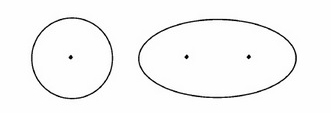
1. In an ellipse, if the two focuses (foci) separate from each other, we get eventually something like a hotdog! If they get too close to each other, we have made a circle.
2. Either way, we no longer have a true ellipse; items of machinery that use the ellipse principle would suddenly not work if the two foci were moved closer or farther away.
3. A real ellipse needs both foci to function, with equal emphasis on each, or it ceases to be an ellipse. For example: if we want a glass of water, we don't ask for Hydrogen. Or for Oxygen. To get water, we must create H2O; that is, both Hydrogen and Oxygen are needed in the water ellipse. We can't have one without the other!
4. Theological truths always use the elliptical pattern; for example, God is one focus of the ellipse, and man is the other. In a way, as far as we are concerned, we can't have one without the other.
5. For example, the ellipse of salvation needs grace and faith; if we want salvation, we can't have grace without faith and vice versa.
6. The ellipse of the gospel can be expresses by joining pardon and power; pardon is only a partial gospel and thus is not what God intended.
7. When we want to understand Christ's role in our salvation, we note that He is both our Substitute and our Example—we don't have one without the other.
8. When we want to understand Christ's work as our Savior, we see Him on the Cross and we see Him as our High Priest—we don't have one without the other.